
Idaho Resident Lookup: Evidence by Record
Idaho has no single public list that proves where every person lives. The statewide tools answer different questions, while a county assessor, clerk or recorder holds many address-linked records. Treat each result as evidence of only what that record was made to show, and keep its date and county attached.
| Record | What It Can Confirm | Where to Check | Access Route |
|---|---|---|---|
| Parcel or deed | Owner, parcel and recorded property interest, not who occupies it | County assessor, GIS or recorder | County portal, map, counter or recorder index; coverage varies |
| State-court case | Public case number, parties, filing history and listed events | Idaho iCourt | Public search; courthouse kiosk, county clerk or copy request for fuller records |
| Voter status | The person's own current registration and election information | VoteIdaho status tool and county clerk | Free individual status check; bulk reports require a separate request and lawful use |
| Vital certificate | A registered birth, death, marriage or divorce event | Idaho Vital Records | Public after the set confidentiality period; otherwise eligible requesters apply with ID |
| License or business filing | License status, business role or registered office | DOPL or SOSBiz | Public online verification; certification or paper filing has separate steps |
| Directory, yearbook or obituary | Historical name, place, school or family context | Library and Idaho State Archives collections | Catalogs, on-site research, or a records/research request |
Choose a starting point from the question: a court case belongs in iCourt, a public credential in the licensing search, and a family event with the vital-record custodian. An address question usually begins with the county parcel record. If the starting clue is an address, the Idaho street-address directory follows that separate parcel-to-record path.
Idaho Resident Lookup Through iCourt
iCourt's public portal is the statewide starting point for Idaho district and magistrate case information. Smart Search offers case, party and business routes, while a separate Search Hearings mode uses a date range. A name result can show a case number, parties, case type, filing or event chronology, hearing, status, disposition or judgment when those fields are public. The exact display changes by case and access level.
| Search choice | Citation, case number, party name, business name or driver's license number when present on the case. |
|---|---|
| Party name fields | Last name and first name; the payment guide also requires date of birth for its party route. |
| Case number | Enter the full number, with or without dashes. Use the spelling and punctuation shown on a prior filing. |
| Business search | Use the exact case spelling; the official guide recommends an asterisk for uncertain spelling, such as Wal*. |
| Typical result fields | Case or citation number, file or citation date, party name, case type, events, hearing and any public balance or disposition. |
Sealed cases and information exempt under ICAR 32 do not appear, and a portal summary is not the full case file. For a fuller record, use the county courthouse kiosk or ask the clerk in the county where the case was filed. Idaho Courts' records access instructions describe requests and response steps.
Insider tip. A no-result screen can mean the wrong court layer, spelling or county; it does not by itself establish that no case exists.
Note: A public portal search can miss records sealed by order or rule, and a no-result screen is not proof that no case exists.
Idaho Resident Lookup and Voter Status
VoteIdaho's Check Your Voter Record is an individual status tool, not a public ZIP or neighborhood browser. The current client-rendered route asks for a name and date of birth and may require a session or CAPTCHA. Its intended result is the person's registration status and election information, which can change after an address update or election administration work.
The registration form describes data such as prior and current names, separate residential and mailing addresses, county and precinct. Optional phone and email are marked as public-record information on the form, but that does not make every internal field a public directory field. A public bulk report follows another process through the Secretary of State or county clerk.
The current VoteIdaho voter-status form shown below is the official statewide self-check; its captured path displays name and date-of-birth inputs.
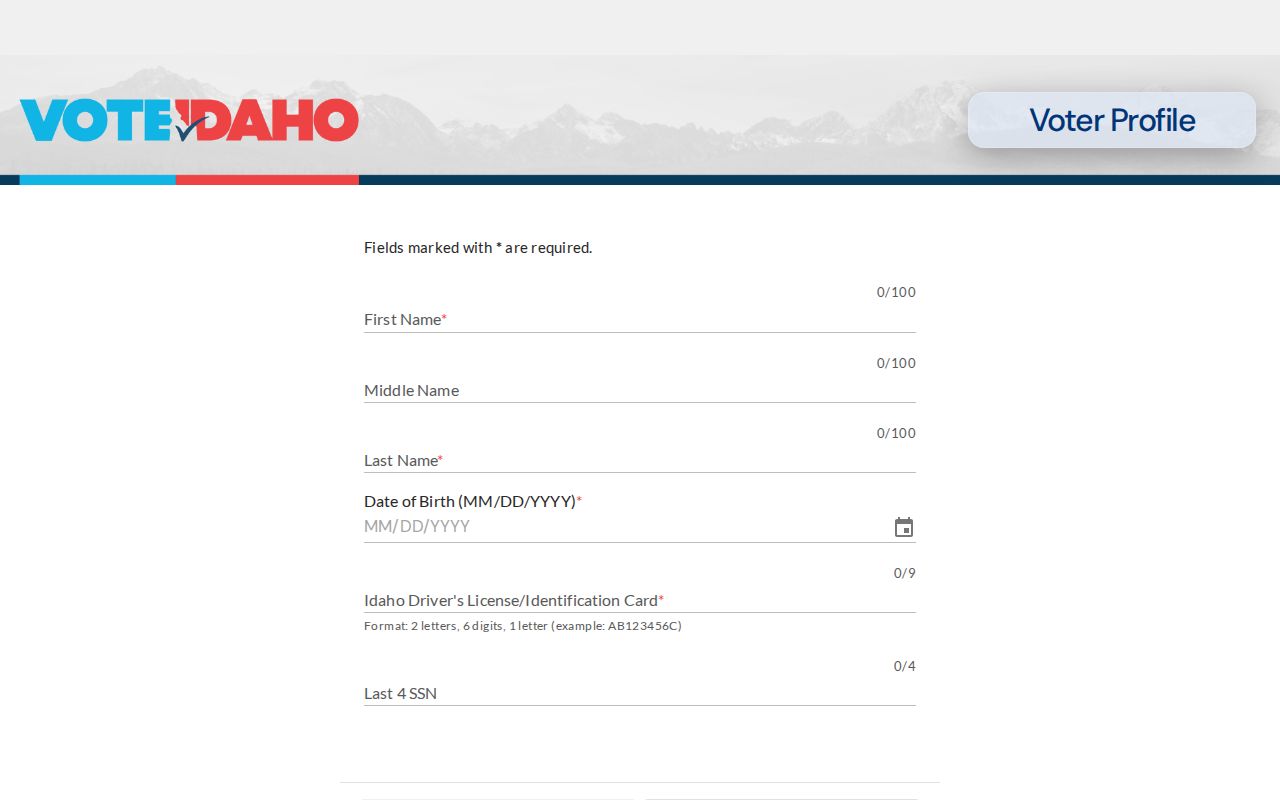
The captured form is rendered by the live application, so not every label or result field was visible to the text inspection. Save the lookup date, and direct a disputed precinct or address question to the county clerk.
Idaho Vital Records for a Resident Search
Idaho's Bureau of Vital Records and Health Statistics issues statewide certificates. Birth records are confidential for 100 years; death, marriage, divorce and stillbirth or miscarriage certificates are confidential for 50 years. For a confidential record, the applicant must fit an allowed relationship or legal purpose and provide the required identification. A public event index or newspaper notice does not make a certified certificate open.
Applications can be made through the state instructions, by mail, or through VitalChek, which adds service charges. The marriage and divorce request form asks for the event date and Idaho city, parties' names, relationship, purpose, signed ID and payment. The listed certificate fee is $16 per copy, with a one-time $10 rush option. A divorce certificate confirms an event; the actual decree is held by the county court clerk. County, church and archive indexes can help with events before state coverage, but each custodian's surviving records differ. For birth-parent connections, the Department's Voluntary Adoption, Putative Father and Abandoned Child Registries are official, narrow routes; adoption files are not ordinary public records.
Note: A certificate confirms a vital event, while the full divorce decree remains with the county court clerk.
Idaho Business and License Lookup
Business and professional records can confirm a person's public role without establishing a home address. SOSBiz shows entity status, type, registered agent, principal or registered office and filing history when recorded. Its UCC search is a separate way to check debtor or secured-party filings. A county clerk or local recorder may hold assumed-name filings; Idaho has no single statewide public DBA search identified in the research.
DOPL's public license search can show a legal license name, number, type, status or expiration and public board action, depending on the profession. Online verification is free. An official certification request uses a separate form and carries a $10 fee. Complaints and investigations are exempt under Idaho Code §§74-106(9) and 74-113(3)(a). A license or registered office identifies a credential or filing relationship, not a person's home address.
Idaho Resident Lookup in Archives
For a former classmate, relative or earlier household, the State Archives' yearbooks, newspaper indexes and biographical resources can provide dated context. Yearbooks cover 1909-2006, and the Archives describes newspaper holdings from 1863 forward. The Boise Public Library obituary and local-history collection includes Polk directories, telephone books, reverse directories, newspaper indexes and Sanborn resources. Such a result is a lead to test against a second source, not proof of a present address.
The Idaho State Archives accepts research questions by email, mail or in person; its Research Center is at 2205 Old Penitentiary Road in Boise and is open Wednesday through Saturday, 10 a.m. to 4:30 p.m. Call 208-334-2620 to check access before a visit. An heir search may also start with a probate case and personal-representative filing; the Secretary of State's Will Registry reveals only basic will-location information to heirs, beneficiaries or other interested people after death, not the will's contents.
Note: Match a yearbook, directory or obituary by county and date before tying an old entry to a living person.
Idaho Resident Lookup and Registry Limits
The Idaho State Police Central Sex Offender Registry is a specific statutory record, not an all-resident directory. Its search modes include name, city, county, ZIP and map. Public entries may show names, aliases, birth dates, residence or student address, physical description, offense and photograph; protected identifiers such as Social Security and driver's-license numbers, phone numbers and online identifiers are withheld.
The official Idaho registry search states that fingerprint verification is the positive identity link. A name and birth-date match alone can be wrong. The registry warns against harassment or intimidation, and Idaho Code §§18-8326 and 18-8413 address criminal consequences for misuse.
The Idaho State Police registry page below shows the available search modes.
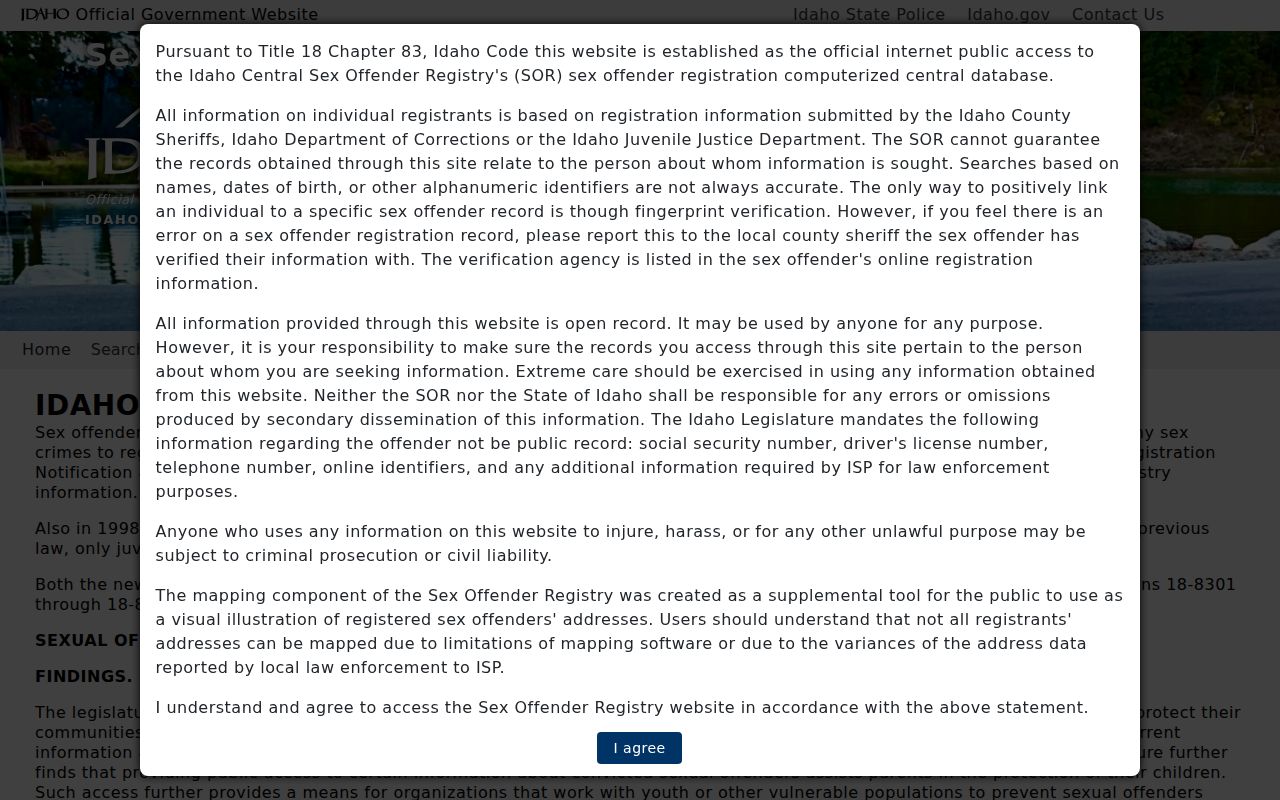
Use this route only when the record question concerns the registry itself; a ZIP or map result is not a general list of Idaho residents.
Verify an Idaho Resident Across Records
For a one-person check, preserve the source and date of each result, then compare independent records. A name plus ZIP is a weak match, particularly when the name is common or a family member shares initials. Keep prior names, county and the time period in view before drawing a conclusion.
- Write down the exact name, any prior spelling, and the county or time period tied to the question.
- Choose the record that directly answers it, such as an iCourt party search or a vital event request.
- Compare a second record from another custodian, using date, county, case number or parcel rather than name alone.
- Ask the custodian to correct a wrong field or explain a record limit; do not fill gaps by guessing.
- Docket
- A court's sequence of filings and events in a case.
- Index and image
- An index points to a record; the image or full file is the underlying document and may require a clerk or copy request.
- Certified copy
- A copy issued by the custodian with an official certification for a permitted purpose.
Idaho Records Requests When a Lookup Stalls
When an online result stops at a summary, make a narrow request to the office that holds the record. Name the record class, county, date range and known case, parcel or instrument number, and say whether a copy or inspection is needed. The Idaho Public Records Act gives agencies up to 10 working days to respond to Idaho residents and up to 35 days for nonresidents. For qualifying Idaho residents, the first two staff hours and first 100 pages are free; allowed labor or copying costs can apply afterward.
The Secretary of State's public-records request route handles its records and voter-report requests; use the official county clerk directory to reach the local custodian. Court records can be requested from the county clerk, while historical material may require an archive or library inquiry. A request cannot open a confidential vital record, ACP-protected address, sealed court filing or exempt licensing investigation.
Note: The office that created a record controls its correction or redaction path; another portal cannot change the source entry.
Idaho Resident Lookup Privacy and Limits
Idaho has no universal public data-broker deletion right identified in the official sources reviewed. A broker may have its own removal process, but removing a copy does not erase the source county record. Courts follow ICAR 32; juvenile, sealed, adoption, expunged and other protected material may be absent. A missing result therefore does not prove that an event never happened.
The Address Confidentiality Program gives survivors of domestic violence, sexual assault, stalking, human trafficking or malicious harassment a substitute mailing address, mail forwarding and confidential voter registration. Certification lasts four years and may be renewed or cancelled. An ACP substitute address is a routing tool, not evidence of a participant's physical location. Idaho Code §74-120 bars voter-report data from use as a mailing or telephone list. A commercial data broker may offer its own removal route; submit only the required verification, save the confirmation and recheck because information can return.
Lawful use. Idaho records support personal, lawful research. Do not use a name or address to stalk, harass, intimidate or harm anyone, and do not republish private identifiers that a custodian withholds.