
Idaho Previous Residents Across Eras
One Idaho address can leave different marks in the state’s records. A deed follows title, a directory can place a name or business at a street, a census describes a household in its census year, and a map can help show that an old street label still points to the same block. No single Idaho index joins those trails. Start with the Idaho record that best fits the era, then compare its parcel, legal description, address and date with another Idaho source.
| Source | Years It Covers | Where Held | What It Shows |
|---|---|---|---|
| Idaho county deed index | Canyon example: 1864–1997 microfilm; 1984 to current online index | Idaho county recorder, auditor or clerk/auditor | Ownership transfers, liens, legal description and recording dates in Idaho |
| Boise, Idaho Polk city directories | 1891 to current at the library; Archives holdings detailed through 1945 | Boise Public Library and Idaho State Archives | Name, address, occupation or business and Idaho household clues |
| Boise, Idaho Hill-Donnelly cross-reference | As published: 1969–1970, 1872–1991, 1993–2004 | Boise Public Library, Idaho | Street or address to listed occupant or business in Idaho; verify the year |
| Federal census for Idaho | Public through 1950 under the 72-year rule | National Archives, Idaho State Archives and library databases | Household members, age, relationship, occupation and Idaho residence in the census year |
| Reconstructed 1890 Idaho index | Records dated 1885–1894 in selected counties | Idaho State Archives searchable indexes | Substitute clues from land, tax, probate, court, vital, newspaper and other records; not a census |
| Idaho Sanborn maps | Boise 1912–1949, with a 1956 republication; Idaho Falls 1921–1948 | Library of Congress and local collections | Building footprint, block, street labels and use clues, not residents’ names in Idaho |
| Boise, Idaho building permits | Current Accela records; historical cutoff not stated | City of Boise portal or records request | Idaho project timing, applicant/contact, inspections and documents |
| Idaho obituary and probate trail | Boise obituary index 1957–2017; newspaper coverage 1864 to current | Boise Public Library, Idaho State Archives and county court | Death, relatives, an Idaho address or an estate endpoint |
Start a recent transfer at the assessor and recorder; for an older household, compare a directory, census or newspaper near the date with deed and map evidence. Coverage is county-specific. Record the town, county, volume year and custodian for each clue; no Idaho office keeps one complete historical occupant list.
Idaho Deed Records for Past Residents
To follow an Idaho address backward, use its parcel and legal description. The county assessor links an Idaho parcel to an owner name, tax mailing address and land description, but not to proof of occupancy. Search the recorder’s Idaho grantor/grantee index; the seller-to-seller steps below show how to keep moving backward.
- Use the present address to locate its county and parcel; keep the situs address separate from a tax mailing address.
- Copy the parcel number and full legal description, including lot, block, subdivision or metes-and-bounds wording.
- Search the current owner as grantee for the likely purchase period and deed type.
- Open or request the deed, then record grantor, grantee, recording date, instrument number, book/page and legal description.
- Search the grantor as an earlier grantee for the same land, and repeat seller by seller.
- When the online index ends, move to the county terminal, deed books or microfilm, and ask the recorder staff about earlier records.
- Grantor / grantee
- The party giving a property interest / the party receiving it in a recorded instrument.
- Chain of title
- The sequence of recorded transfers that links one owner to an earlier owner.
- Legal description
- The formal land description; it can identify a parcel when the street address changes.
A deed may name a trust, corporation, estate or joint owner, not a household. Mortgages and releases show activity without a sale; tax deeds or probate can break the chain. Keep instrument type and date, and follow the legal description when a name or address stops lining up.
Idaho Past Residents: Index Limits and Microfilm
Idaho county recorder tools differ in both years and image access. Latah County’s public form accepts a partial or full name in “Lastname, Firstname” order or an instrument number. Idaho online results are capped at 5,000, and documents over 50 pages cannot be viewed online. A result still gives enough detail to ask for an official copy. The Latah County recorded-document index is the source for this Idaho search example.
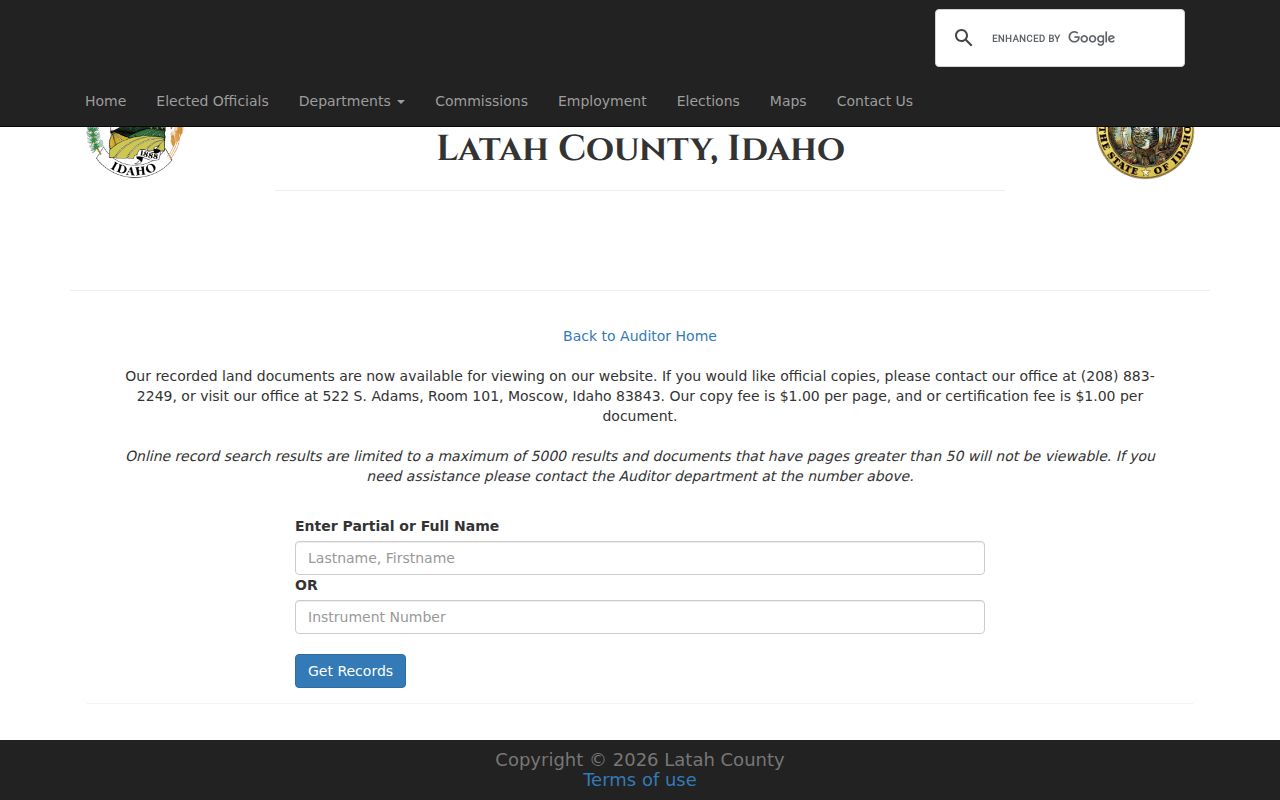
The screenshot shows Latah’s search fields; narrow the index before requesting a copy.
| Search entry | Partial or full name in “Lastname, Firstname” order, or an instrument number. |
|---|---|
| Document | Document or instrument reference for the recorded item. |
| Book and page | Recording location shown with the index result. |
| Party | Party name and party type, such as a grantor or grantee role. |
| Type and length | Document type and total pages; items over 50 pages cannot be viewed online. |
Official Idaho copies for Latah come from the Auditor at 522 S. Adams, Room 101, Moscow, Idaho 83843, phone 208-883-2249. The published charge is $1 per page and $1 per document for certification. Canyon County shows a different access pattern: its Idaho index covers 1984 to current, but images are viewed at the Recorder’s public terminal; records from 1864–1997 are on microfilm. The office accepts public-record requests by email and has microfilm readers at 111 N. 11th Street, Suite 330, Caldwell, weekdays 8 a.m. to 5 p.m., phone 208-454-7555. These are county examples, not Idaho-wide coverage dates.
The Canyon County Recorder can direct a researcher to its document search and office route. The index, image and certified copy are separate access steps.
Idaho Previous Residents in City Directories
Deeds name transfer parties, not every occupant. A city directory can place a name or business at a street in a particular year. Boise Public Library lists Polk books from 1891 to current, telephone books from 1948 to current and Hill-Donnelly cross-references. Its year notation is irregular, so confirm a particular issue with library staff. The Idaho city directory collections page explains the holdings and entry marks.
When a surname is unknown, try the address-order section, then check the name entry and that year’s key. “r,” “h” and “bds” vary by volume. A street listing may name a business or subscriber, not every resident; a missing entry can reflect a run gap, address variant or index limit. Keep the year and page, then compare a census or newspaper before assigning the entry to a family member.
Idaho Past Residents and Sanborn Map Clues
Sanborn maps can bridge an Idaho address when a street label has changed. Boise has sheets from 1912–1949 and a 1956 republication; the 1912 set has 85 sheets. Idaho Falls has 34 sheets from 1921–1948. The maps show building footprints, blocks and use clues, not residents’ names. Match the map sheet to the parcel before connecting a past address.
Open the Library of Congress Boise Sanborn collection or the Idaho Falls Sanborn sheets. An Idaho map can show that a building or block existed, but a directory, deed, permit or census is needed to link a name to it. If the number differs, compare block position, lot lines and legal description rather than assuming the modern address was used in the old source.
Idaho Past Residents and Street Changes
Idaho has no single statewide street-renaming or renumbering chronology in the research sources. If an old address is missing from a current parcel search, bridge it with subdivision plats, annexation records, city street-name files, Sanborn sheets and directory indexes. Jurisdictions matter: Boise city records differ from Boise County records, and Idaho County is a separate county with Grangeville as its seat.
Keep the original and modern address forms together with town, county, street spelling, number, lot and block, parcel ID and legal description. A plat or recorder index may use a legal description while a directory uses a street address. Outside Boise, ask the city clerk or planning/GIS office about address history by parcel or street; local indexes vary.
For present-day Idaho owner and parcel steps, follow the separate Idaho street-address record sequence; use those current records only to locate the same land through time.
Pairing Idaho Previous Residents with Census Records
A directory and a census answer different questions in Idaho. The directory can give a name and street in a year when it was published; the federal census can show a broader Idaho household in its census year. Public schedules are available through 1950 under the 72-year rule. Idaho State Archives lists federal schedules from 1790–1930, while Boise Public Library’s HeritageQuest includes 1790–1950 and PERSI. Pair the nearest dates, but do not treat a directory year as an Idaho census count.
- Choose the closest directory year before or after the census year that names the address.
- Compare the census household’s names, ages, relationships and occupation with the directory entry.
- Check another directory year for a move or a changed name, and note any gap in the local run.
- Use a deed, probate record or newspaper item to test a family relationship or date.
The federal 1890 census is a special gap: most schedules were destroyed by fire in 1921. Idaho’s reconstructed 1890 index draws on 1885–1894 records in selected counties, including land, tax, probate, court, vital, newspaper and directory sources. This Idaho index points to surviving evidence, not a full census. Unknown first names may appear as “[?],” and multiple hits can reflect different Idaho record types.
Idaho Previous Residents and Permit History
Boise, Idaho’s Permitting & Licensing portal can add a date to a building’s history. Its Building search includes record number, type and status, date range, project name, person or organization, street-number range, street name and parcel number. Exact-address help says to put the number in the “From” field and leave “To” blank; street-name search can use an exact or partial form. An Idaho result may show the location, parcel, applicant/contact, description, status, fees, inspections, uploaded documents and related records.
The Boise building-record portal gives limited information without an account; a free account is needed for complete application histories, invoices, receipts and status functions. No historical retention cutoff is stated. Outside Boise, Idaho, use the city clerk or planning department’s public-records page and request the address history by parcel or street address. An Idaho permit can date construction or a remodel, but it does not establish who lived there at the time.
Idaho Past Residents in Obituaries and Probate
Idaho newspaper notices and probate files can close a household trail. Boise Public Library’s Idaho Statesman database covers July 26, 1864 to current, and its obituary index spans 1957–2017. The Idaho library accepts requests for obituary, death-notice and clipping items by email, mail or fax; the listed fee is $5.25 per located item, up to four obituary or article requests per week. Specific directory or telephone-book pages cost $1.25 each, limited to five pages a week. These charges apply to located pages, not to an assurance that a record exists.
Idaho State Archives holds Idaho newspaper microfilm from 1863 to present and accepts research requests by email, mail or in person; fees may apply. A probate file or recorded estate transfer can add a representative or heir link, but sealed or exempt court records may not appear online. Idaho iCourt provides Idaho case information; the filed county clerk or courthouse kiosk is the route when the full file is not on the portal. Use an Idaho cemetery listing as a lead and confirm a death or identity with an obituary, certificate or court record.
Lawful use. Use Idaho records for family history, house history and personal research. Do not use an address clue to stalk, harass or harm a living person.